
 Crear una cuenta de estudiante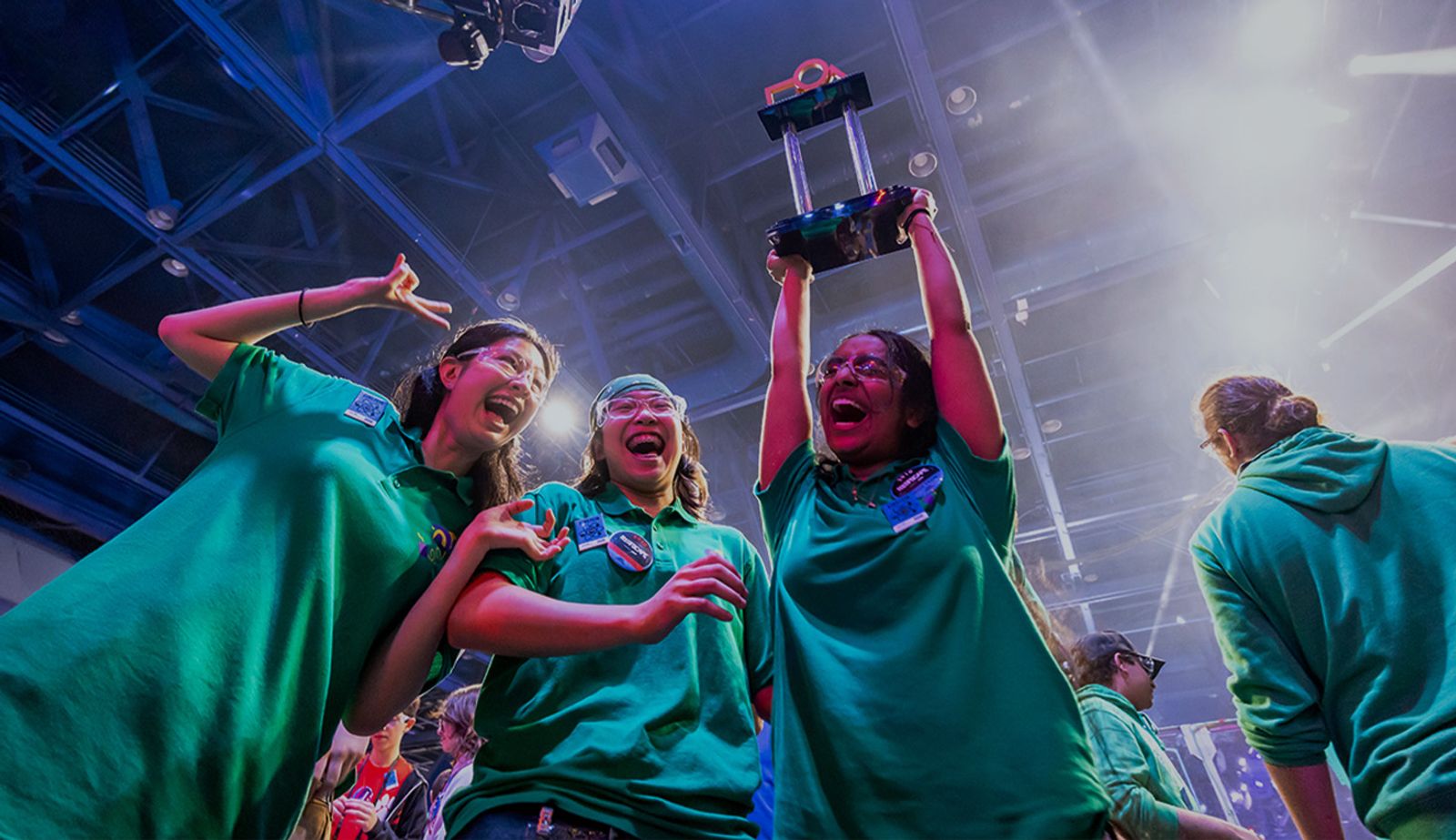
05:43
Summary: FRC Team 2910 shares how its robot, Spectre, was designed, iterated, and refined in Onshape on the path to winning the 2025 FIRST Robotics World Championship.
We are Team 2910 Jack in the Bot, a high school robotics team based at Henry M. Jackson High School in Mill Creek, Washington. We are part of the FIRST FRC program, which challenges us to design, build, and program industrial-sized robots to compete in themed games each year.
Since our founding in 2009, we have competed in over 50 events and earned numerous technical awards along the way. This year, we had a standout season with a 66-7-0 record, ultimately taking home the win at the FIRST Robotics World Championship in Houston.
Why FRC Team 2910 Uses Onshape
Team 2910 uses Onshape for several reasons that support how we design and build as a team, including:
- Real‑time collaboration, allowing multiple team members to work on the same parts and assemblies without overwriting changes
- Intuitive assembly mating, which streamlines how we define and build assemblies
- Browser‑based access, making CAD available on any device without requiring high‑powered computers
- Automatic saving and offsite backups, giving us confidence that our work is always reliably and securely saved
- Strong training resources and a well‑designed interface, which help onboard new team members during the off‑season
Onshape’s cloud‑based architecture enables real‑time development anywhere and anytime, and after two years of use, we have been very happy with it.
Building Spectre to Be Reliable and Nimble
To reach our goal of winning the world championship, our team determined early in the build season that our robot would need to complete all major game tasks. The design subteam ultimately designed Spectre, a robot that was reliable, easy to service, and able to play any role in the alliance. As with our other robots, Spectre was quite small and nimble.
Drivebase
The drivebase was a typical tubular chassis design with an omnidirectional drivetrain enabled by swerve modules from Swerve Drive Specialties.
To move the center of mass forward and counteract the arm’s motion, we added a 10-pound solid brass ballast bar to the front of our chassis. The battery was also placed in the front for the same reasons: easy access and to keep the center of gravity low.
All of the major electronics are mounted to the drivebase. The battery and robot controller are mounted with custom 3D-printed TPU (thermoplastic polyurethane) covers for shock isolation.
Pivot
The pivot is a compact, highly integrated design combining the gearbox that drives the pivot, the gearbox that drives the arm extension, and the structure that supports the arm’s pivot axle. We wanted the pivot to be very robust and stiff, so we decided to make it a dead axle mounted to an A-frame. Both gearboxes, driven by three motors, are mounted in the drivebase to lower our center of gravity. The pivot also mounts our four vision systems, which enable automated alignment to the field’s scoring structure from the front and back.
The pivot dead axle is attached to the A-frame with two end plugs, structurally connecting the top of the A-frame. One of the design criteria we set for ourselves is that our robot must be easy to fix in the event of damage.
Spectre’s arm can be time-consuming to repair, so we designed the pivot connection to allow the arm to be quickly removed and replaced with a spare. By removing a single bolt that holds the two end plugs together, the entire arm can be easily disconnected and removed.
This quick-swap feature is augmented by our match setup procedure, which sets the arm’s pivot, extension, wrist, and climber axes to zero positions with a single button after they are held against their hard stops. This enabled us to eliminate any sensors that might need recalibration when swapping to a spare arm.
Arm
The arm provides 3 degrees of freedom to move the game piece intake to all necessary positions: rotation around the pivot, a 2-stage telescoping extension, and a rotational wrist at the end of the extension.
The arm design was based on our 2023 robot, Phantom, but was improved based on our experience with that version. Leveraging a previous design we were familiar with allowed us to focus more on the other aspects of our robot’s unique features for the 2025 game, like the intake and climber. Our familiarity with this design made assembly and repairs smoother, as well.
Intake
Given the requirement to intake game pieces instantly in any orientation, we conducted extensive prototyping and iteration to meet those goals.
We initially used wheels with different durometers to shuttle the Coral (the “Coral” is one of the game pieces, which is a 4-inch OD PVC pipe that is 11.875 inches long) to the center of our intake, where it was held.
In later versions, we used time-of-flight sensors to detect the Coral’s position in the intake and automatically move it in the direction we needed.
Climber
The climbing challenge involved grabbing and hanging from a suspended cage structure. We determined very early in the design process that our ability to compete at the highest levels of play would require a fast and consistent climber.
The importance of the climb was one of the main reasons we chose the arm design, since it could also serve as the main actuation for the climb. Mounting onto the outside of the arm, the climber uses compliant wheels to intake the cage into a set of one-way latches.
By monitoring the climber wheel velocity and the associated motor current consumption, the robot would detect that we had possession of the cage, and the arm would then pull down and lock into place to complete the climbing sequence. The active cage acquisition and fast arm motion combine for a climb that takes only 1.5 seconds.
The climber was also designed to slide along the arm’s fixed stage on a carriage. We do this so that we can grab near the top of the cage and pull down as the arm rotates and locks. This ensures the chain suspending the cage is directly above Spectre’s center of gravity, preventing it from swinging and touching the ground.
Iteration Builds a Winning Robot
The 2025 season was quite the experience for our team. From winning every district event we attended to claiming our first-ever World Championship title, the journey was filled with challenges, growth, and unforgettable moments.
We pushed our team and robot to their limits and learned the importance of constant iteration, which Onshape enabled to happen efficiently. Each event revealed new opportunities for improvement, whether it was refining our intake, improving autonomous consistency, or strengthening match execution.
While we’re incredibly proud of what we achieved, we know that this success didn’t happen by chance. It was the result of dedication, late nights, and a shared drive to grow stronger with every competition.
Onshape for Education
Get started with Onshape and join millions of students and educators worldwide.
Latest Content
- Estudio de caso
- Aviation, Aerospace & Defense
Dufour Aerospace Accelerates Critical Cargo Drone Delivery with PTC’s Onshape and Arena
02.11.2026 Más información- Blog
- Evaluating Onshape
- integraciones
- Colaboración
AI in Onshape: From First Features to AI Agents
03.19.2026 Más información- Blog
- Customers & Case Studies
- Education & Universities
Spectre: The Robot That Won the 2025 FRC World Championship
03.18.2026 Más información- Blog
- Robótica
- integraciones
Streamlining Robotics Development with Onshape and NVIDIA Isaac Sim
03.17.2026 Más información