
 Créez un compte étudiant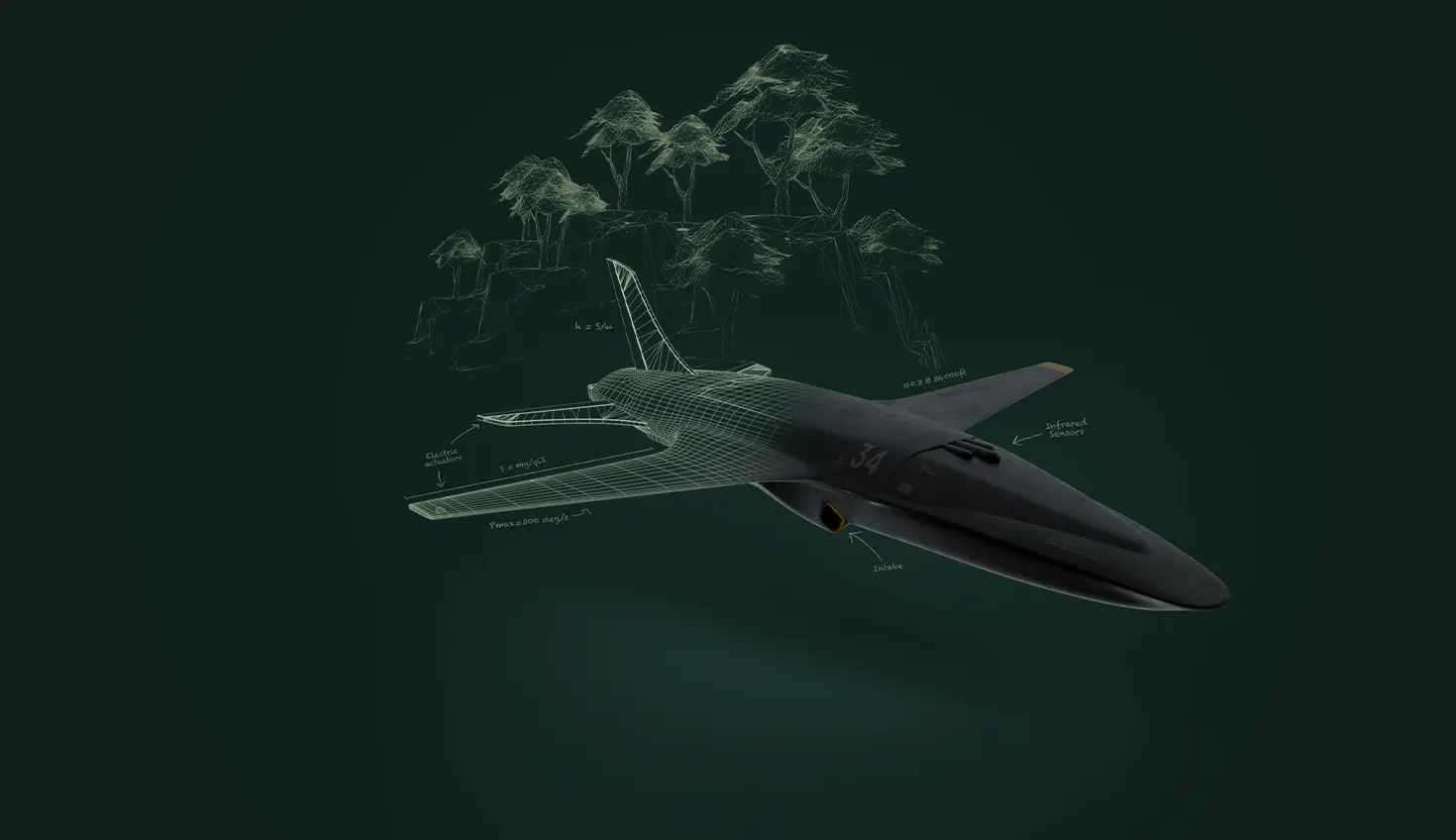
04:01
Résumé rapide
- The Rainforest is a 20-person team inside Saab, one of the world’s most established defense companies.
- They are building a drone on a timeline that redefines what’s possible in aerospace.
- The team uses Onshape, leveraging collaboration tools and API integrations.
Saab, an aerospace and defense company based in Stockholm, Sweden, is known for designing submarines, aircraft, and radar systems.
But within the company, a 20-person team called The Rainforest is doing something different. They’re building a one-ton drone, or UAV (unmanned aerial vehicles), on a timeline that would be considered aggressive by any standard in aerospace – just 24 to 48 months for a development cycle that traditionally spans decades.
This is how they’re doing it and what engineering teams in aerospace and defense, or any industry, can take from their process.
Building an UAV to Go Where Nothing Else Can
The mission behind Rainforest is to develop disruptive product concepts that create new market segments and keep people and society safe.
The UAV they’re building is a one-ton fixed-wing drone to prove a simple idea: A fast, autonomous aircraft can deliver safer outcomes in both civil and military missions. The drone is designed for speed, range, and autonomy, with emergency response use cases like locating people lost at sea and mapping disaster zones. It can deploy quickly, carry a meaningful payload, and cover wide areas, often reaching locations faster or more cost-effectively than helicopters, ground vehicles, or manned aircraft.
With a design this size, the team also needs to scale. To do so, they chose Onshape and grew the team from seven to 20.
The Largest 3D-Printed Fuselage in the World
The Rainforest’s fuselage is currently believed to be the largest 3D-printed aerospace structure in the world: 5 meters, or about 15 feet, long, printed as a single part, with topology-optimized internal geometry.
The workflow is as follows: The outer geometry is created in Onshape, exported to a manufacturing partner for structural load analysis and topology optimization, then 3D printed. The resulting mesh is imported back into Onshape, where all detail design continues.
Onshape supports hybrid mesh handling, allowing mesh and parametric geometry to coexist in the same environment, so the rest of the design can be built around the optimized structure without leaving the platform.
How They Made Aerospace Design Faster
Traditional aerospace development is sequential – simulations feed CAD, CAD feeds testing, testing feeds feedback, and every handoff adds time. The Rainforest built a different kind of process. Here’s what it looks like.
Creating a Pipeline That Runs Itself
The aircraft’s geometry is driven by Python code. That code runs simulations, evaluates performance, and calls the Onshape API to update the CAD model automatically. Onshape returns mass properties, center of gravity, and inertia data, which feeds back into the simulation models. Results appear on a live dashboard on the office wall, visible to the whole team in real time.
A design change in the morning surfaces as a mission-level consequence, such as reduced range or longer takeoff distance, before the end of the day.
No More Throwing Designs Over a Fence
In a conventional workflow, a designer can intend for a part to be manufacturable without getting real feedback until it reaches the shop floor.
When manufacturers are working directly in the Onshape environment, they can review geometry, leave comments on the actual model, flag production concerns before anything goes to print. That feedback arrives during design rather than after it and problems that would have become program issues get resolved at the geometry stage, when they’re cheap to fix.
Onshape’s real-time collaboration means the people building the parts and the people designing them are never working from different versions, resulting in less surprises for the shop floor, quicker production, and lower costs
The Toolchain That Ties It All Together
The full development stack – GitLab for version control, Onshape as the geometry and data hub, simulation environments, and the avionics deployment pipeline – is connected through the Onshape API. A single code commit kicks the entire chain. Every tool in the stack is reading from and writing back to the same source.
The result is a development cycle that produces around 50 times more iterations than a conventional aerospace workflow – not because the tools are faster, but because nothing gets lost between them.
Defense-Grade Security Without the Overhead
For aerospace and defense organizations evaluating cloud-native CAD, compliance is a prerequisite.
Onshape Government complies with key standards to support customers with ITAR and EAR requirements, and is pursuing FedRAMP Moderate authorization. PTC is aligning with CMMC 2.0 Level 2 controls for defense contractors.
Cloud-native access controls and complete audit trails reduce both compliance overhead and security risk without compromising the development benefits that make the platform valuable in the first place.
Une collaboration CAO en temps réel qui permet à tout le monde de rester synchronisé
Design simultaneously and see updates instantly in one shared CAD environment; no file management required.
Contenu le plus récent
- Blog
- News from Onshape @ PTC
- Artificial Intelligence
- Caractéristiques personnalisées
From Onshape Labs, the FeatureScript MCP Server: The Fastest Path to AI-Driven Design
08.11.2026 En savoir plus- Blog
- Becoming an Expert
- Gestion de données
15 choses à savoir avant d'importer des fichiers CAO dans Onshape
08.06.2026 En savoir plus- Blog
- Evaluating Onshape
- Model Based Definition
- PCB Studio
- Rendu
- Simulation
- Intégrations
Onshape Features That Keep Your Design Data Connected: August 2026 Highlights
08.05.2026 En savoir plus