
 Create a Student Account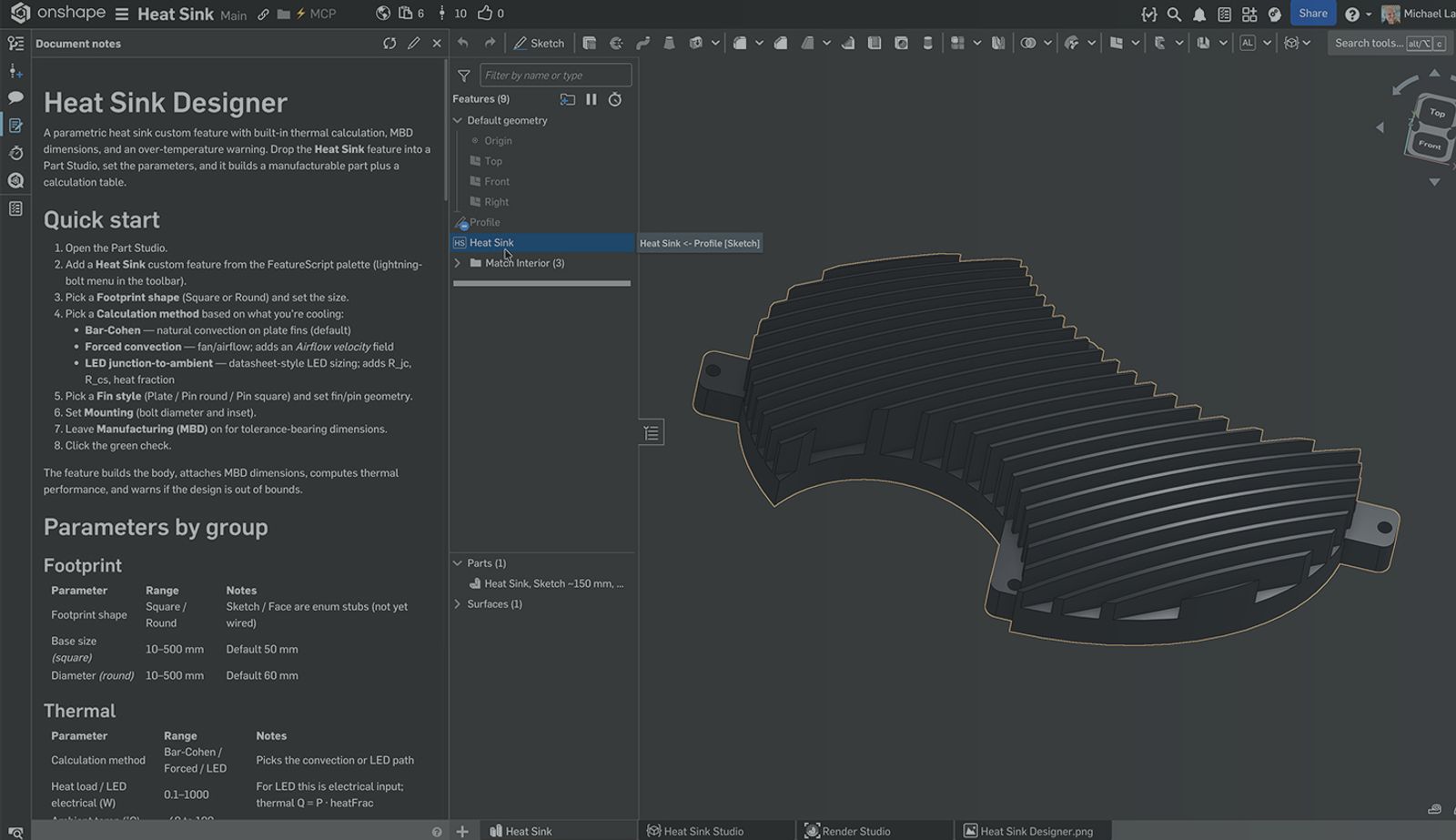
03:55
Summary
- Document notes can be used as a markdown space for sharing plain text explaining a design.
- This Tech Tip offers copy-ready markdown for five jobs: theory of operation, driving the parametrics, reference data, the math behind your numbers, and requirements.
Onshape already provides a natural home for most kinds of information. A question or a quick heads-up belongs in a comment. Revision changes belong as release notes. A single value, such as a part number or material, belongs in a property. Each of these tools is built with a purpose, and you should lean on them.
However, one kind of information falls outside their scope: The standing reference that explains a design, that is, how it works, and how to drive it when it is parametric. That knowledge typically lives in someone’s head, or is buried in a file nobody can locate. Document notes, the markdown workspace attached to your Onshape document, is where it belongs.
Markdown is simply text with a thin layer of structure. A handful of symbols yield headings, tables, lists, and formula blocks, and the source stays legible even as raw text. Below are the patterns that earn their place in document notes, the ones the other tools cannot accommodate, with examples you can copy and adapt.
Markdown Supported in Onshape Document Notes
Element | Syntax | Notes |
Heading 1 | # Text or Text underlined with ==== | Both ATX (#) and Setext (underline) styles |
Heading 2 | ## Text or Text underlined with ---- | Both styles work |
Headings 3-6 | ### Text through ###### Text | Closing hashes (### Text ###) also accepted |
Bold / italic | **bold**, *italic* | Standard traditional Markdown |
Unordered lists | -, *, or + | All three markers are interchangeable |
Ordered lists | 1. 2. 3. | Numbered |
Blockquotes | > quoted text | Can span multiple paragraphs |
Nested elements in blockquotes | > with headers, lists, code inside | Docs explicitly show headers, lists, and code blocks nesting inside a blockquote |
Code blocks | Indented or fenced code | Shown inside the blockquote example |
Hyperlinks | [text](url) | Help page repeatedly cites “text, Markdown, and hyperlinks” |
Element
Syntax
Notes
Heading 1
# Text or Text underlined with ====
Both ATX (#) and Setext (underline) styles
Heading 2
## Text or Text underlined with ----
Both styles work
Headings 3-6
### Text through ###### Text
Closing hashes (### Text ###) also accepted
Bold / italic
**bold**, *italic*
Standard traditional Markdown
Unordered lists
-, *, or +
All three markers are interchangeable
Ordered lists
1. 2. 3.
Numbered
Blockquotes
> quoted text
Can span multiple paragraphs
Nested elements in blockquotes
> with headers, lists, code inside
Docs explicitly show headers, lists, and code blocks nesting inside a blockquote
Code blocks
Indented or fenced code
Shown inside the blockquote example
Hyperlinks
[text](url)
Help page repeatedly cites “text, Markdown, and hyperlinks”
A Quick Way to Decide What Goes Where
If it is a question or a quick note to a teammate, use a comment. If it is what changed in a release, use release notes. If it is a single metadata field, use a property. If it is a reference that explains the design, how to use it, or the data behind it, use document notes. Everything below sits firmly in that final category.
Pattern 1: Theory of Operation
The geometry shows what the design is. It says nothing about how it works or why it took that form. That standing explanation has no native field in Onshape, and it is precisely what markdown excels at.
## How This Bracket Works
The sensor mounts at three points, not four, on purpose. Three
points define a plane with no over-constraint, so the housing
will not warp if the mounting surface is slightly out of flat.
The slotted hole on the right lets the bracket grow about 0.4 mm
under thermal load without binding the sensor. Keep that slot if
you revise this. It is doing real work, not just clearance.
A teammate who reads this grasps the design’s logic before touching it. Without it, the slotted hole reads as sloppy tolerancing, and someone “fixes” it into a plain round hole.
Pattern 2: How to Drive the Parametrics
If your document is heavily parametric, the single most valuable thing you can document is how to operate it: which variables to change, what they drive, and what to leave alone. No other tool holds operating instructions for the model itself.
## How to Make a New Size
This document is parametric. To generate a new frame size:
1. Open the "Master Variables" tab
2. Set frame_width and frame_height (valid 200 to 1200 mm)
3. The weldment, gussets, and drawing update automatically
4. Check the cut list on the "Drawing" tab before release
Do not edit the weldment sketch directly. It is driven by the
variables above, and manual edits get overwritten on rebuild.
This transforms a model that only its author can operate into one that anyone on the team can use correctly.
Pattern 3: Reference Data That Informs the Design
Lookup data you relied on while designing, but that never appears in the geometry, belongs here. For example, a property holds a single value, so a table of related values is markdown’s domain.
## Fastener Reference (this assembly)
| Location | Size | Torque | Notes |
|----------|------|--------|-------|
| Lid to body | M4 | 2.5 Nm | Brass insert, do not overtorque |
| Bracket | M6 | 9 Nm | Loctite 243 |
| Ground lug | M5 | 5 Nm | Star washer, no thread locker |
Torque values and thread-locker notes are exactly the sort of detail that gets passed around verbally and then lost. A small table beside the model preserves it with the design permanently.
Pattern 4: The Method and Assumptions Behind Your Numbers
When a dimension derives from a calculation or a standard, record the method and the assumptions, not merely the result. This is a reference, not a change record, so it has no business in release notes. Markdown’s formula block keeps it legible.
## Why the Wall Is 3.2 mm
Wall thickness is set by injection molding limits, not by load.
The pressure check below confirms load is not the governing case.
Hoop stress (thin wall): sigma = P * r / t
P = 0.5 MPa, r = 40 mm
At molding minimum t = 3.2 mm: sigma = 6.25 MPa
Allowable (PA6-GF30, safety factor 2): 25 MPa
Large margin. Thinning the wall to save material will not help,
because manufacturability is the limit, not stress.
The last line is the payoff. It stops a future engineer from “optimizing” a wall that was never load-driven in the first place.
Pattern 5: Requirements and Intent
Properties capture the values the design landed on. They do not capture what the design was trying to achieve. A short requirements table with a “why it matters” column gives the geometry its context.
## Design Requirements
| Requirement | Target | Why it matters |
|-------------|--------|----------------|
| Operating temp | up to 120 C | Mounted next to the motor |
| Service access | 50+ open cycles | Filter inside is field-replaceable |
| Ingress | IP54 | Dusty site, no immersion expected |
When someone proposes a change, this table tells them instantly whether it breaks a requirement or just a preference.
Use Multiple Markdown Tabs for Bigger Designs
Here is something many people overlook: Onshape can render an entire tab as a markdown file. The formatting does not display, but the full text sits right there in the document, so you are not confined to a single notes field. On a larger project, you can maintain several markdown documents as tabs: theory of operation in one, a parametric user guide in another, and reference data in a third. Each lives alongside the model and stays as plain text.
Because it is all plain text, it travels well. You can export it, search it, or hand it to an AI assistant that can ingest your reference and help you reason about the design.
A Few Habits That Keep Notes Useful
Write for the reader with zero context, because eventually that reader will be you. Confine it to a standing reference, and let comments, release notes, and properties carry conversation, change history, and metadata. Update the notes in the same motion as the model so the two never drift apart. Keep it lean. A clear theory of operation and one solid reference table outweigh three pages that nobody reads.
This Tech Tip provides the markdown patterns that belong in document notes. If you want to go deeper into parametric design, check out our resources on FeatureScript custom features.
Friends Don’t Let Friends Use Old CAD!
Know a colleague who could benefit from our cloud-native, fully-featured collaborative design platform?
Latest Content
- Blog
- Becoming an Expert
- Assemblies
Built to Scale: Why Large Assemblies Don’t Slow Down in Onshape
07.16.2026 learn more- Blog
- News from Onshape @ PTC
- Artificial Intelligence
Onshape Labs: AI in CAD Guided by Designers, Driven by Innovation
07.15.2026 learn more- Blog
- Evaluating Onshape
- Data Management
- Collaboration
- Artificial Intelligence
How the Most Underrated CAD Feature Improves Design Workflows
07.09.2026 learn more