
 Create a Student Account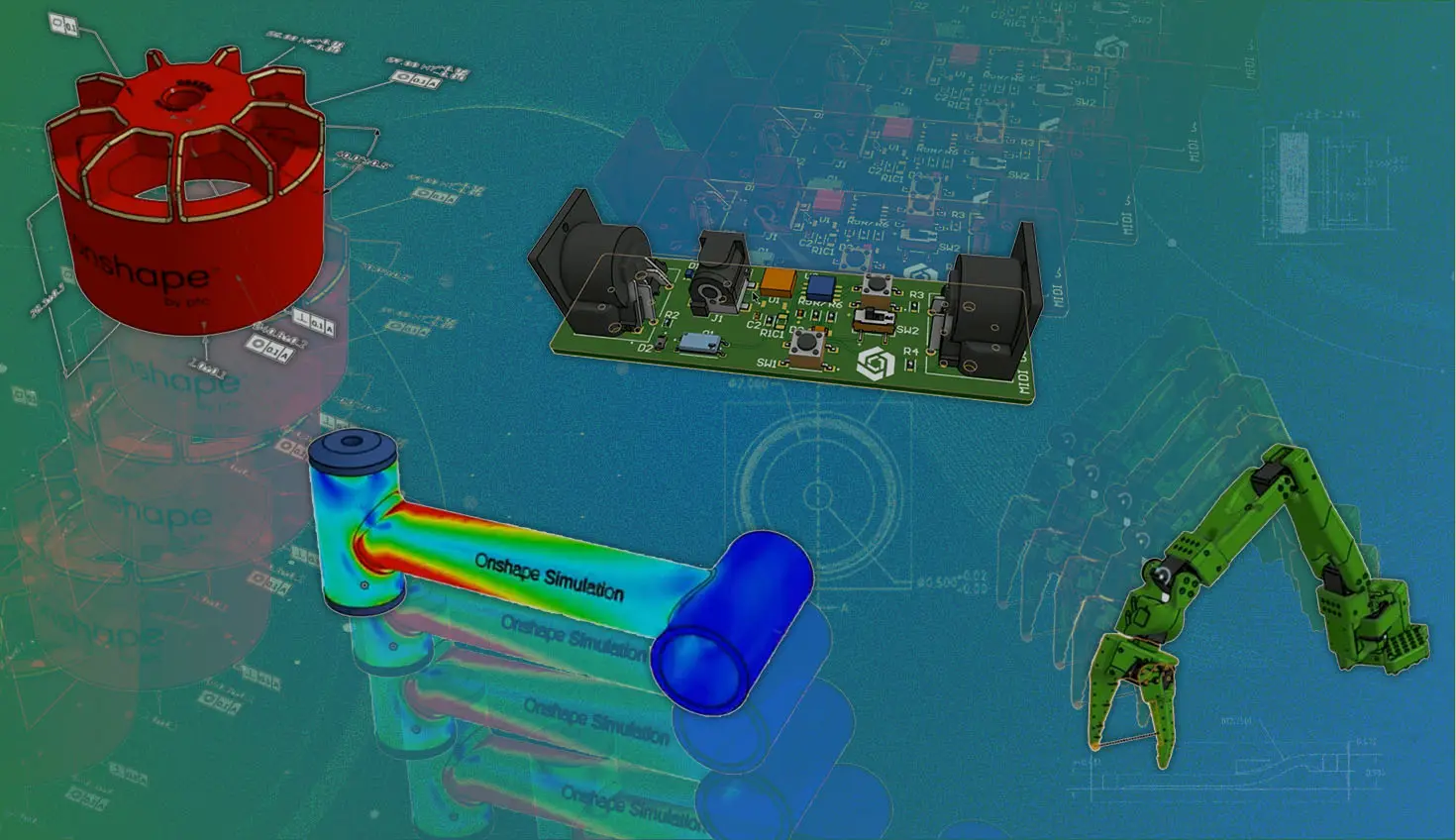
05:08
Summary
- Connected product development depends on data surviving every handoff, from electrical to mechanical, from design to inspection, and from CAD to simulation.
- Onshape's three-week release cadence delivered on all of them this quarter: cloud-to-cloud ECAD collaboration, persistent simulation results, MBD collaboration, and expanded robotics export.
Modern products are mechanical, electrical, embedded, and increasingly autonomous, all built by teams spread across companies and tools. Every one of those boundaries is a place where product data gets exported, flattened, re-created, and quietly desynchronized.
That’s what connected product development is meant to solve: one continuous thread of data from concept through manufacturing, where nothing has to be rebuilt just because it crossed into another tool or team.
Onshape delivers toward that goal every three weeks. New features, improvements, and fixes arrive automatically the moment you sign in – no downloads, no patches, no IT involvement, nothing to do to your existing documents. Seventeen releases a year, each validated against millions of real documents before it reaches you.
Below are the highlights from the last five releases.
ECAD Collaboration with One Shared Component Library
The Altium 365 connector with Onshape PCB Studio is direct, cloud-to-cloud integration.
The practical win is component library management. Electrical and mechanical teams traditionally maintain parallel libraries – often per user – and reconciling them is a permanent tax. Here, Altium’s component models are used directly by Onshape and managed in an Onshape document, so the whole organization works from one set.
READ: How Onshape PCB Studio Pulls 3D Component Models Straight from Altium 365
Because components arrive as linked references rather than imported bodies, your assembly stays lightweight no matter how dense the board. New hole tagging means plated and non-plated classifications survive the round trip in both directions, and hole filtering suppresses hundreds or thousands of holes from view without touching the underlying ECAD data.
Filter MBD Annotations and Comment Directly on Them
Onshape MBD is built into the platform for every user, from free through enterprise and education.
READ: Single Source of Truth from Design to Manufacturing and QA
Annotation filtering is associative and type-based. Rather than maintaining a view for every combination you need to communicate, filter live on distance, angle, or geometric tolerance – datums are always visible. Any annotation added later appears in the right filter without further work.
Additionally, Onshape’s threaded comments and action items now attach directly to annotations and cross-highlight to both the model and the inspection table. A question about whether a tolerance is really necessary lives in the tolerance itself. In most systems, that conversation requires an add-on.
Centerline dimensions can now carry tolerances, so annotations exist on revolved geometry the moment it's created.
Simulation Results That Persist Beyond Your Session
Simulation results now persist in the cloud, independent of the session that produced them. You can close your browser or turn off your machine while studies run, and the solved results remain ready for you or your team on any device.
Because results are saved directly with the document, you can instantly compare multiple load cases and design iterations without spending time re-computing.
URDF Export with Full Mesh Control for Robotics
Robotics design work ends with the model leaving CAD entirely, bound for NVIDIA Isaac Sim or another physics environment where it will be articulated and trained against thousands of tests.
Native URDF export now supports OBJ, STL, and GLTF meshes, text or binary STL, and resolution control across all formats. That last option matters: collision and visual geometry have opposite requirements, so controlling each separately means no longer trading simulator performance against visual fidelity.
Three additions speed the design work itself. Section views can now use the default front, top, right, and side planes – significant on curved robot geometry.
Measurements update dynamically as the assembly articulates, turning clearance checking through a range of motion into a live readout. Mate connectors can reference other mate connectors, so tool center points and pickup frames no longer need intermediate geometry.
Release Assemblies Despite Faulty Imported Parts
Supplier files arrive with faults. Onshape flags them correctly, however, a cosmetic fault in a purchased part shouldn’t block a release.
You can now ignore faulty part warnings on specific components. The override clears the warning at the assembly level, and the release proceeds.
Exact Routing Curve Lengths and Custom Sketch Colors
Routing curves gained multi-point move and, more usefully, target length. A pigtail off a connector is a fixed length – the real question is whether it will route between two points without violating its bend radius. Now you specify the length and let the curve solve for it, with curve analysis running alongside to report minimum radius as you adjust.
Sketch graphics preferences answer a long-standing request. Under-constrained entities are no longer locked to blue, which isn’t differentiated enough from black. Choose your own color, line thickness, and construction-geometry dash spacing.
Live Navigation and Explicit Lights in Render Studio
Live navigation in Render Studio keeps viewport performance smooth as you interact with large assemblies. By leveraging real-time viewport estimation during camera movement, models maintain their visual context rather than collapsing into bounding boxes as the full cloud scene enriches.
New explicit lights create direct illumination without needing geometry including point, disk, sphere, infinite, and cylindrical lights with diffuse, spotlight, or manufacturer-accurate IES profiles. Paired with EXR environment lighting, placed light panels, and custom background imagery, setting up studio-quality visual assets is fast, flexible, and completely integrated.
CAD That Keeps Getting Better
Every capability above arrived through the normal release cycle, automatically and safely, with no migration project and no version event to plan around.
The theme connecting these features is simple: your data should stay usable wherever it goes next. Stay tuned for new developments.
Stay in the Loop with Onshape Labs
Fill out the form so you’re first to know, first to try, and first to weigh in on everything Onshape Labs releases next.
Latest Content
- Case Study
- Robotics
Automation Within Reach Saved $40,000 Annually & Accelerated Iteration by 50% with Onshape
09.22.2026 learn more- Blog
- Evaluating Onshape
- Data Management
- Drawings
- Artificial Intelligence
How Onshape is Redefining the Manufacturing Handoff with MBD and AI
09.24.2026 learn more- Blog
- Data Management
- Integrations
- Government (US)
With Quarter20 and Onshape, Database-Driven Documentation from Design to Production
09.23.2026 learn more- Blog
- Evaluating Onshape
- Bill of Materials
- Branching & Merging
- Data Management
- Release Management
CAD and PDM Capabilities That Speed Up Every ECO
09.17.2026 learn more